A manual lathe needs a trained operator to position the workpieces and select the cutting tools. Usually, these tools use high-speed steel (HSS) that contains chromium, tungsten, vanadium, and carbon. These lathes are best for symmetrical parts that can easily get clamped in the spindle.
A CNC metal lathe produces components with brilliant dimensional accuracy. It can work with different materials, including metal, wood, and glass. These machines, first designed by the American John T. Parsons in the 1940s, use Computer Numerical Control. G-Code (Geometric code) and M-Code (miscellaneous) programs control the motion and function of a CNC machine, directing the feed rate, spindle speed, etc.
Many CNC and manual lathe cutting tools are similar, using HSS, tungsten carbide, etc. But some are unique, like face drills and polygon turning.
Both machining processes are different in point of cost, accuracy, operating team and time. CNC machining is less time consuming, easy to operate, and expensive compared to Manual machining. While on other side Manual Lathe method required highly skilled & experienced team, time consuming but cheaper comparing to CNC method.
CNC full form is Computer Numerical Control. This auto machine process can be used for shaping all metal, plastic or wood. This is controlled via computer programs. The accurate programming plays an important role for precision components and machined parts.
Compared to Manual Lathe, CNC Lathe offer tight tolerances, and complex and custom shapes. For repetitive jobs and exact shapes, the CNC automated process is best. But the CNC Lathe is more expensive than the Manual so for small scale it may not be suitable. CNC process can handle all types of jobs from the smallest to large machined parts with superior finish. CNC machining can be performed for all types of steel and non-ferrous material including nickel alloys and titanium.
Manual Lathe is a traditional and labor-oriented process to shape the material. This method is very time taking and not suitable for complex shapes. Turning, drilling, and cutting through Manual lathes can be done for low-budget projects. Small workshop still prefers Manual Lathe for cheaper and affordable machined components. Also, Manual lathes are easy to maintain and material waste can be handled by labor which saves a lot of cost.
Laser
Milling
Press Brake
Press Brake
Difference between vertical lathe and horizontal lathe
However, vertical lathes offer strong clamping due to the gravitational benefit. They are better for heavy components in aerospace and occupy less floor space.
Table of Content
Stainless steel pipe specifications
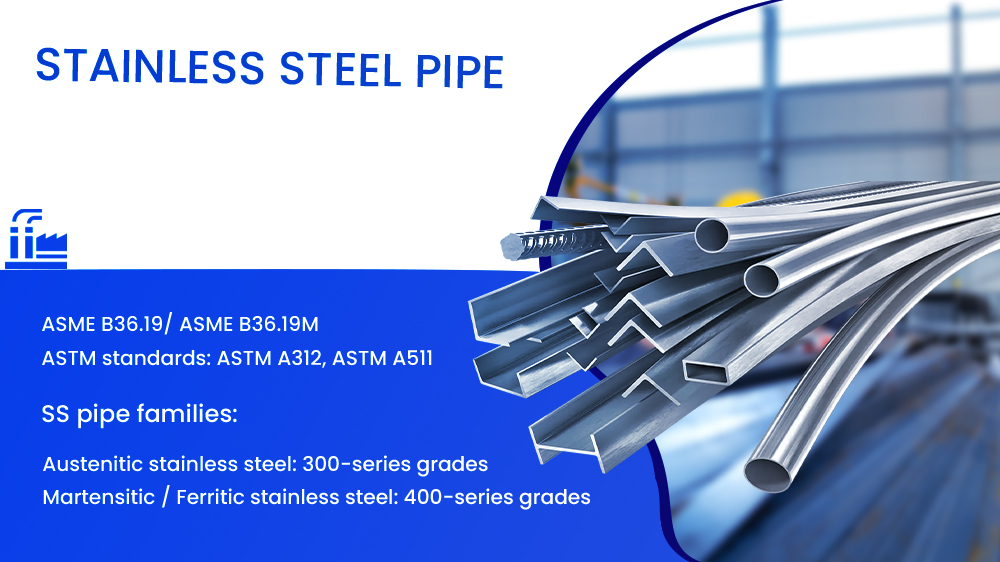
Groups of SS pipe
ASTM standard for stainless steel pipe
Types of stainless steel pipes
ASME B36.19M vs ASME B36.19 stainless steel pipe
Main difference between SS pipe and a tube
Suffix “S” meaning in schedule of ASME B36.19 pipe
Schedule of ASME B36.19 stainless steel pipe
ASTM A312 stainless steel pipe permissible variations
SS Seamless pipe dimensional tolerances as per ASTM A530
Stainless steel pipe imperial and metric (SI) units
OD, NB & Schedule of SS pipe
Stainless steel pipe weight per foot
6 types of SS pipe ends
Stainless pipe class
List of most common defects after quality check
Measurement of SS pipes
List of mechanical tests performed by SS pipe suppliers
Stainless steel pipe burst pressure
Features of stainless steel seamless pipes
Value added services offered by SS pipe suppliers
Grades of stainless steel pipe
Stainless steel pipe specifications
| Nominal Pipe Size ( SS pipe NPS size range ) | SS pipe OD | SS pipe DN sizes |
|
|
|
| Wall Thickness | Suitable for these types of fluids | Meet standards |
|
|
|
| Shape | Surface finish and treatments | Stainless steel seamless pipe |
|---|---|---|
|
|
For custom length please contact below listed SS pipe suppliers in UAE |
| Packing | ASME standard for SS pipes | SS pipe material group |
|
|
|
| SS Pipe price per meter | Top 18 global & leading stainless steel pipe manufacturers name | Pipe wall types |
|
Above are the well known leading name in manufacturing SS seamless pipes, you can contact below listed stainless steel pipe suppliers for stock availability and dealer price list |
|
| Applications | List of supporting documents | SS Pipe finishing treatment |
|
This check list may be helpful for all who deal in SS pipes like suppliers, manufacturers, stockist, traders or buyers
|
|
| SS pipe manufacturing methods | Production method of SS seamless pipe | How to order? |
|
Contact below listed verified companies directly and get the complete details about ready stock sizes, price and estimated delivery in Middle east. |
Groups of SS pipe
| Material sub-groups | Series | Content | Machinability |
|---|---|---|---|
| Austenitic Stainless Steel | 300 | Nickel up to 15% | 35%-75%. |
| Ferritic / Martensitic Stainless Steel | 400 | Chromium up to 18% | 40%-75%. |
| Duplex pipe | – | Chromium up to 30% & Nickel up to 9% | 20%-30% |
ASTM standard for stainless steel pipe
SS pipe manufacturers use different ASTM standards for making pipes.
| American standard stainless steel pipe | Manufacturing/ forming method | Description |
| ASTM A312 / A312M -08A (Most popular standard) | Seamless/ Welded (For Pipe) | Austenitic Stainless Steel Pipe |
| ASTM A269 / A269M | Seamless/ Welded (For Tubing) | Austenitic Stainless Steel |
| ASTM A790/ A790M | Seamless/ Welded | Ferritic/ Austenitic Stainless Steel Pipe |
| ASTM A511 | Seamless | Stainless Steel Mechanical Tubing |
| ASTM A1016/ A1016M-02A | Seamless/ Welded (For Tubing) | Stainless Steel |
| ASTM A943/ A943M | Spray-formed, Seamless | Austenitic Stainless Steel Pipe |
| ASTM A949/ A949M | Spray-formed, Seamless | Ferritic/ Austenitic Stainless Steel Pipe |
| ASTM A872/ A872M | Centrifugally Cast | Ferritic/ Austenitic Stainless Steel Pipe |
| ASTM A999 | General Requirements | Stainless Steel Pipe |
| ASTM A814 / A814M | Cold-Worked Welded | Austenitic Stainless Steel Pipe |
| ASTM A554 | Welded | Stainless Steel Mechanical Tubing |
| ASTM A813 / A813M | Single- or Double-Welded | Austenitic Stainless Steel Pipe |
| ASTM A358 / A358M | EFW | Austenitic Chromium-Nickel Stainless Steel Pipe |
| ASTM A1053 /A1053M | Welded | Ferritic / Martensitic Stainless Steel Pipe |
| ASTM A376/ A376M | Seamless |
This ASTM specification cover below 7 grades (Five H grades & two Nitrogen grades) |
Types of stainless steel pipes
Types of stainless steel pipes vary by grade, shape, and how they’re made.
SS pipe types based on different grades (most selling grades)
| DIN Grades (Germany) |
ASTM Grades (USA) |
SUS/ JIS (Japan) |
BS (UK) |
UNI (Italy) |
EN Grades (Europe) |
|---|---|---|---|---|---|
| 1.4541 | A312 TP321 | SUS321 | 321S 31 | – | X6CrNiTi18-10 |
| 1.4571 | A312 TP316Ti | SUS316Ti | 320S 33 | – | X6CrNiMoTi17-12-2 |
| 1.4301 | A312 TP304 | SUS304 | 304S 15 304S 16 304S 18 304S 25 En58E |
X5CrNi18-10 | X5CrNi18-10 |
| 1.4306 | A312 TP304L | SUS304L | 304S 11 | – | X2CrNi19-11 |
| 1.4307 | A312 TP304L | SUS304L | – | X2CrNi18-9 | |
| 1.4401 | A312 TP316 | SUS316 | 316S 29 316S 31 316S 33 En58J |
X5CrNiMo17 12 X5CrNiMo17 13 X8CrNiMo17 13 |
X5CrNiMo17-12-2 |
| 1.4404 | A312 TP316L | SUS316L | 316S 11 | – | X2CrNiMo17-13-2 |
SS pipe types based on different shapes
Oval
Stainless steel square pipe
Stainless steel rectangular pipe
SS pipe types based on different manufacturing methods
Stainless Steel ERW pipe
SS pipe types based on different uses and applications
Sanitary pipe
Mechanical pipe
Polished stainless steel pipes
SS pipe types based on wall thickness
Thin wall
Thin wall
Double wall
Related Posts
Building the World with Quality Metals
When you work with us, you gain access to a wealth of knowledge, expertise, and a commitment to innovation that will
elevate your projects.
Our Clients